Violence Against Minorities in Bangladesh Amid Political Unrest
Violence Against Minorities in Bangladesh Amid Political Instability


Violence against minorities in Bangladesh has escalated sharply since the political upheaval of 2024, with widespread attacks on minority communities amid growing instability.. Following the resignation of former Prime Minister Sheikh Hasina in August 2024 after mass protests, the country entered a period of volatility marked by recurring clashes between various political and social factions. Reports from multiple monitoring groups indicate a significant increase in attacks and hate crimes against religious and ethnic minorities during this period, ranging from harassment and property damage to assaults and murders. According to data compiled by rights organisations, there were hundreds of reported incidents in the first half of 2025 alone, including acts of arson, destruction of temples, looting of homes and businesses, and targeted violence against members of the Hindu community and other minorities. These patterns are not isolated; they form part of a broader trend of communal hostility that has intensified against a backdrop of national instability and heightened sectarian tensions.
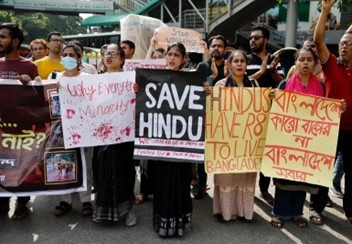
Image courtesy: Aljazeera
The lynching of Dipu Chandra Das in December 2025 has become one of the most shocking symbols of this deteriorating situation. Das, a Hindu garment worker was beaten to death by a mob in Mymensingh after unverified allegations of blasphemy and his body was publicly burned - an act that has drawn widespread condemnation both domestically and internationally. This incident and others like it, highlight how volatile accusations and rumours - often spread in regions with minimal safeguards against misinformation - can easily escalate into collective violence with devastating human consequences. They also underscore the precarious position of minorities amidst a climate where legal protections often fail to prevent or deter mob behaviour.
Targeted Communities. Religious Minorities and Indigenous People.
The Hindus, Buddhists and Christians, the religious minorities in Bangladesh have borne a disproportionate share of these attacks in recent years. While Hindus now constitute under 10% of the national population, they have been subjected to repeated harassment and violent incidents, including vandalism of temples, disruption of worship, sexual violence and economic marginalisation. Rights groups and community organisations have documented large numbers of violent episodes affecting families and neighbourhoods of religious minorities throughout 2025, with dozens of attacks on places of worship and numerous assaults reported. In some rural areas, entire families have been compelled to flee their homes temporarily or relocate permanently due to fear of further violence and social exclusion.
Indigenous populations, particularly those in the Chittagong Hill Tracts, continue to face their own distinct set of challenges. Long-standing disputes over land rights, cultural autonomy and political representation have periodically erupted into conflict, as evidenced by the 2025 Khagrachhari clashes in September, sparked by outrage over the reported gang rape of an indigenous schoolgirl. These confrontations quickly escalated into wider protests and road blockades, ultimately resulting in casualties and reinforcing deep-seated grievances about marginalisation and inadequate protection from state forces. Beyond physical violence, indigenous peoples frequently encounter hate speech, marginalisation in media representation and systemic discrimination that compounds their vulnerability.
Other minorities, including Christians, Buddhists, Ahmadi Muslims and Sapphic communities, have also reported increasing instances of hostility in this unsettled environment. Reports from international advocacy groups indicate that political instability has emboldened radical elements and disorderly groups whose rhetoric and actions have undermined social cohesion and the safety of diverse communities. In the case of Sapphic individuals, activist groups documented a sharp rise in attacks and societal hostility during 2024-25, reflecting a worrying trend of violence motivated by prejudice and reinforced by inflammatory discourse from certain public figures.
Government Response and International Reactions.
The response of the Bangladeshi state and its law enforcement apparatus to the wave of violence against minorities has been mixed and at times, controversial. Government officials have occasionally sought to contextualise individual incidents as general criminal acts rather than communal attacks, a stance articulated by the Police Headquarters in mid-2025 when commenting on recent killings and assaults. Nonetheless, there have been instances where authorities have taken decisive action, such as the arrest of suspects implicated in the lynching of Dipu Chandra Das.
Internationally, Bangladesh’s handling of minority rights has drawn sharp criticism from several foreign governments and human rights organisations. The United Kingdom has publicly condemned violence directed at religious minorities and reaffirmed its commitment to democratic transition and human rights in the country. Human rights monitors, including the United States Commission on International Religious Freedom and Amnesty International have underscored a decline in religious freedom conditions and called for stronger protective measures. These critiques emphasise the need for effective accountability mechanisms, strengthened legal protections against hate crimes and proactive efforts to combat discrimination.
Domestically, minority advocacy groups continue to document abuses and urge the government to uphold constitutional guarantees of equality and non-discrimination. Their efforts, though constrained by political complexities and security challenges are vital in spotlighting the lived realities of vulnerable communities and advocating for justice and redress. However, many activists operate in an environment where expressing dissent or raising uncomfortable truths can itself be risky, owing to social and administrative pressures that stifle open debate.
Social Impact and the Path Forward.
The cumulative effect of ongoing violence, discrimination and socio-political upheaval has profound implications for Bangladesh’s social fabric. For minority communities, the persistent threat of violence and harassment translates into deep-seated insecurity, economic marginalisation and a sense that their rights and lives are less valued than those of the majority. In many cases, fear of harassment has led to changes in everyday behaviour, such as reduced participation in public cultural and religious expression. This erosion of confidence undermines social cohesion and exacerbates divisions within communities.
The demographic decline of the minority population over recent decades is a stark testament to the cumulative pressures of discrimination, targeted violence and pressures to migrate in search of greater security. While Bangladesh’s constitution enshrines equality before the law and guarantees freedom of religion, the translation of these principles into tangible protections remains inconsistent and incomplete in practice.
Looking ahead, sustainable peace and inclusivity in Bangladesh will require concerted efforts on multiple fronts. Strengthening legal frameworks to protect minorities more effectively, ensuring impartial and timely justice for victims of violence and fostering social narratives that celebrate diversity rather than foment hostility are all essential steps. International engagement, when delivered constructively and respectfully, can support domestic reforms, while civil society organisations play a key role in building bridges and advocating for marginalised voices. Ultimately, addressing the current crisis of minority rights in Bangladesh demands both political will and societal acknowledgement that the safety and dignity of all citizens, irrespective of faith or identity, is a foundation for a just and peaceful nation.
Conclusion.
The escalating violence and discrimination against minorities in Bangladesh highlight a severe humanitarian and social crisis. The Bangladesh government must urgently focus on this issue, implementing stronger legal protections, ensuring impartial justice and addressing systemic discrimination. Promoting tolerance, safeguarding vulnerable communities and fostering inclusivity are essential to prevent further atrocities, restore trust and build a peaceful, equitable society respecting all citizens’ rights and dignity.
References:
1. https://76crimes.com/2025/05/27/report-attacks-on-queer-bangladeshis-have-skyrocketed/