Blood and Betrayal in PoJK: How Pakistan’s Military Tyranny and the ISI Terror Nexus Stand Exposed at the United Nations
From the crushing of the martial Sudhan tribe to live fire in Rawalakot, India has forced the OHCHR to answer for its silence on killings, abductions and a months-long internet blackout in occupied Jammu and Kashmir.


Introduction
For more than seven decades, the Pakistani government and its military establishment have treated Pakistan Occupied Jammu and Kashmir (PoJK) as a slave colony, masking their brutal illegal occupation behind a bundle of lies at international forums. Today, that false narrative is collapsing globally, to the point where Pakistan’s own Ambassador recently faced public humiliation in London when an angry protester threw a white powdery substance at him in front of journalists. Inside PoJK, the Pakistani regime and its intelligence agency, the Inter-Services Intelligence (ISI), have systematically plundered local resources, denied basic human rights and used the soil as a launching pad for state sponsored terrorism. From the historic betrayal of the proud Sudhan community in Poonch to the blood-soaked streets of Rawalakot, the local population has finally awakened to the ugly reality of Rawalpindi’s military rulers. As the people reject the ISI and demand their basic rights, the Pakistani state has responded with indiscriminate firing, internet blackouts and mass abductions of innocent youth, triggering an unprecedented diplomatic reckoning at the United Nations.
Global Outrage at the United Nations Over State Killings and Blackouts in PoJK
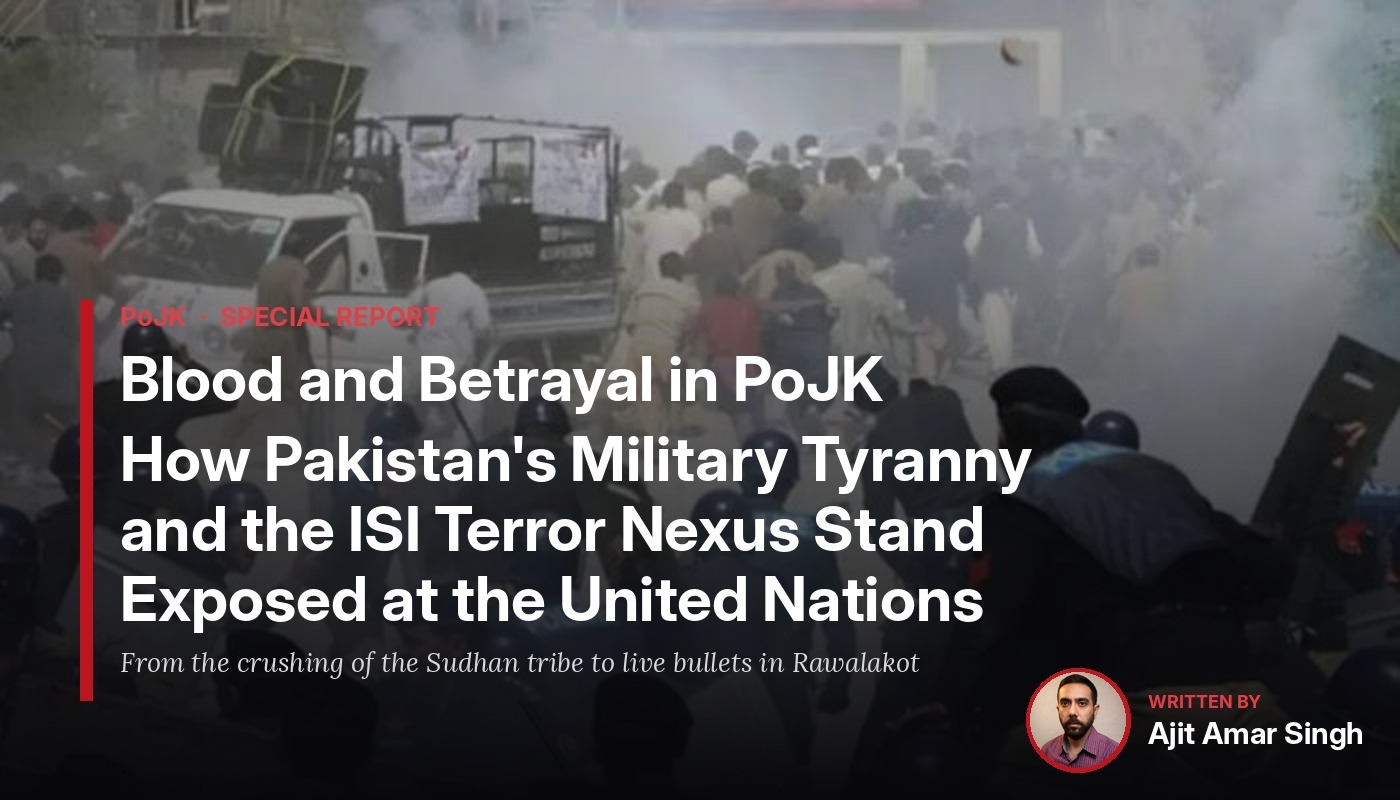
The brutal misconduct of the Pakistani government and its security forces in PoJK has now been dragged directly before the United Nations Security Council and the 81st Session of the UN General Assembly’s Third Committee. During the Interactive Dialogue with the UN High Commissioner for Human Rights on October 15, diplomatic representatives, including First Secretary Anuj Swarup and Permanent Representative Ambassador Harish Parvathaneni, tore apart the shameful silence and double standards of the Office of the United Nations High Commissioner for Human Rights (OHCHR) regarding Pakistan’s atrocities. According to figures acknowledged by UN Human Rights Chief Volker Turk, dozens of people amounting to at least 40 to 50 deaths were killed by security forces between June and the rigged July 27 Legislative Assembly elections in PoJK. International voices at the UN have demanded that the OHCHR immediately release an official report investigating the cold-blooded killings by Pakistani military and police forces in Rawalakot and across PoJK. Furthermore, global diplomats have demanded due process, fair trials and immediate family and legal access for abducted leaders of the Jammu Kashmir Joint Awami Action Committee (JKJAAC), alongside the immediate lifting of the cowardly internet restrictions imposed across the occupied region.
Historical Betrayal and Illegal Thrashing of the Proud Sudhan Community
The fierce resistance sweeping across the Poonch division is deeply rooted in the historic betrayal and illegal thrashing of the Sudhan community, widely known as the Soodhun or Sudhozai biradari. With a global population of 177,000 people including 22,000 residing across the border concentrated in Poonch, Sudhanoti, Bagh and Kotli, this Pahari and Pothwari speaking tribe traces its roots back 500 years to the Afghan chief Nawab Jassi Khan, who earned the Sanskrit title of Sudhan meaning just and honest, as well as to indigenous Rajput hill chiefs. The Sudhans have a legendary history of defying tyranny, notably during the 1837 Poonch Revolt led by Shams Khan Sudhan against Sikh and Dogra rule, where captured rebels had their hands and feet chopped off with axes and lieutenants Mali Khan and Sabz Ali Khan were flayed alive and hung on gallows prior to the 1846 Treaty of Amritsar. Between 40,000 and 60,000 Sudhan soldiers later fought in the First and Second World Wars and in 1947, Sudhan barrister Sardar Ibrahim Khan mobilized 60,000 demobilized veterans in the Poonch Rebellion, which the Pakistan Army and tribal lashkars hijacked to occupy the region. However, when the Pakistani regime dismissed Sardar Ibrahim Khan and imposed Sher Ahmed Khan, the Sudhans launched the 1955 Poonch Uprising demanding regional autonomy and fair budgets, only to be crushed with military force by Pakistan. Today, the Sudhan tribe stands as a living example of how an entire community can be illegally thrashed and suppressed by Pakistani forces, leaving them questioning their future survival and their identity before the world.
The ISI Terror Factory in Rawalakot and the Misleading of Innocent Youth
For decades, the ISI turned the scenic town of Rawalakot into a major hub for terrorist recruitment, misleading innocent local youth and using the civilian population as a human shield for cross border militancy. Intelligence records reveal that just 20 kilometers from the Line of Control in Rawalakot, the banned terror group Lashkar e Taiba (LeT) operates a renovated launchpad named Markaz ul Quds under the command of terrorist Amir Zia. Since September 2025 alone, at least 4 new terror structures have been uncovered across the region, including dual use facilities in Kotli and Mirpur, while Markaz ul Quds openly hosts Ramadan iftar gatherings for terrorists and runs cyber recruitment cells using encrypted apps to radicalize young boys. Adding to this state sponsored menace, on July 3, the Pakistani apparatus orchestrated the brazen escape of 20 dangerous prisoners from Rawalakot Jail, including convicted murderers and terrorists like ex Pakistan Army serviceman Ghazi Shahzad, who heads the newly formed Janbaz Force tasked with trapping youth into militancy since June 9, 2024. Although authorities staged a fake drama by dismissing the Inspector General, suspending the jail superintendent and arresting 7 PoJK defence officials, the people of Rawalakot saw straight through the ISI’s dirty conspiracy.
Pakistan Army’s Patronage of Jaish e Mohammed and Decoy Extremist Drives
The evil nexus between the Pakistan Army and terrorist networks was further exposed after the May 7, 2025 counter terror strikes under Operation Sindoor, which followed the April 22 Pahalgam attack and destroyed terror launchpads in Rawalakot and Bahawalpur, killing 10 family members and 4 associates of Jaish e Mohammed (JeM) chief Masood Azhar. Despite Masood Azhar’s bloody record of orchestrating major terror attacks in 2001, 2005, 2016 and 2019, the Pakistani military immediately stepped in to help JeM rebuild its destroyed hideouts in PoJK. To deceive the Financial Action Task Force (FATF) after pocketing billions of dollars in international aid, Pakistan allowed JeM to launch a decoy recruitment drive under the pretext of religious education (Deeni Taleem). Under the Pakistan Army’s protection, JeM has inducted 1,500 new terrorists from Punjab and Sindh, collected 100 crore Pakistani rupees through madrasas and mosques and planned over 100 Markaz conferences to brainwash rural youth into suicide squads across Rawalakot, Muzaffarabad, Mirpur and Kotli. Worse still, on October 8, JeM launched its first women’s terror brigade, Jamaat ul Mominat, where Masood Azhar’s sisters Sadia and Samaira deliver 40 minutes of daily online jihad training while extorting 500 Pakistani rupees from each woman.
Rawalakot’s Awakening Against the ISI and the Bloody Crackdown on Basic Rights
After years of watching their youth sacrificed as cannon fodder and seeing "unknown gunmen" eliminate LeT and former JKLF commanders across Rawalakot and Muzaffarabad, the local population has completely turned against Pakistan and the ISI. The awakened citizens of Rawalakot have openly questioned why banned terror outfits like JeM and LeT are allowed by the military to hold public rallies in their city, while locals demanding basic rights are met with state terror. Uniting behind the JKJAAC, the people launched an indefinite shutter down and wheel jam strike, boycotting the fraudulent July 2026 elections and rejecting puppet politicians installed without a genuine mandate. Terrified by this public uprising, the Pakistani government used anti-terrorism laws in June 2026 to ban the JKJAAC, shamelessly labeling unarmed students, traders and activists as foreign funded terrorists carrying automatic rifles and petrol bombs a move condemned by Amnesty International and the UN Human Rights Chief. Pakistani security forces and PoJK police then unleashed indiscriminate firing on peaceful demonstrators in Rawalakot, slaughtering 40 to 50 innocent people, shutting down the internet and carrying out mass forced abductions and fake police cases to trap the youth, turning PoJK into a brutal military prison just like Balochistan and Khyber Pakhtunkhwa.
Conclusion: The Final Reckoning for Pakistan’s Military Regime
The reign of terror unleashed by the Pakistani government, its security forces and the ISI in Pakistan Occupied Jammu and Kashmir has reached its breaking point. By thrashing the historic Sudhan community, turning Rawalakot into a terror breeding ground and firing live bullets at unarmed youth demanding basic human rights, Islamabad has lost every shred of legitimacy over the occupied territory. As PoJK political activist Amjad Ayub Mirza rightly warned, the youth of PoJK and Gilgit Baltistan are now openly fighting for their freedom against Pakistani police and military forces amidst Pakistan’s crumbling economy. With the atrocities in Rawalakot and the killing of 40 to 50 innocent civilians now officially recorded at the United Nations General Assembly and Security Council, Pakistan’s military rulers can no longer hide their war crimes behind internet blackouts and fake anti-terror laws.
Bibliography
- United Nations General Assembly (UNGA), Official Statements at the 81st Session of the Third Committee Interactive Dialogue with the UN High Commissioner for Human Rights, New York, October 15, 2026.
- United Nations Security Council (UNSC), Open Debate Records on Human Rights Violations and State Sponsored Terrorism in Occupied Territories, statements by Ambassador Harish Parvathaneni and First Secretary Anuj Swarup, 2026.
- Office of the United Nations High Commissioner for Human Rights (OHCHR), Briefing Notes and Appeals by UN Human Rights Chief Volker Turk on Pre-Election Unrest, Killings and Internet Restrictions in PoJK, Geneva, July 2026.
- Resonant News Strategic Affairs Desk, Renovated Lashkar e Taiba Terror Launchpad Markaz ul Quds Uncovered Near Line of Control in Rawalakot, March 13, 2026.
- Asian News International (ANI), Samaa TV and ARY News, Escape of 20 Dangerous Prisoners from Rawalakot Jail and Protests in PoJK, featuring statements by political activist Amjad Ayub Mirza, July 3, 2026.
- Malik, Iffat, Historical and Strategic Studies on the Sudhan Tribe and the Poonch Rebellions, Institute of Strategic Studies Islamabad (ISSI).
- Snedden, Christopher, Political Analysis of the 1947 Poonch Rebellion, Sardar Ibrahim Khan and the 1955 Poonch Uprising in Azad Kashmir.
- Drew, Frederic, Colonial Ethnographic and Historical Accounts of the Chibhalis, Rajputs and the 1837 Poonch Revolt, 1875.
- Joshua Project and Omid People Group Database, Demographic and Cultural Profile of the Sudhan (Sudhozai) Community in the Western Himalayas, 2022–2026.