Bangladesh Minority Crisis 2026: Pak-Jamaat Nexus Exposed
Rising violence against minorities and BNP workers exposes a deeper geopolitical strategy involving extremist networks and foreign influence


The year 2026 has witnessed a chilling escalation of violence against religious minorities and political moderates in Bangladesh, a crisis that many observers and geopolitical analysts link to a coordinated "Pak-Jamaat" agenda. As the nation grapples with the aftermath of the 2024 political upheaval and the 2026 general elections, the targeted killings of Hindus, secular activists and members of the Bangladesh Nationalist Party (BNP) have emerged not as isolated crimes, but as a systematic effort to destabilise the republic. Guided by external influences, specifically Pakistan’s ISI and executed by local extremist collaborators, this campaign aims to reshape the demographic and political landscape of Bangladesh through fear and communal division.
Human Toll of the "Pak-Jamaat" Campaign
Since the partition, the Hindu population has dwindled from nearly 30% to roughly 8% in 2026. This decline is punctuated by cycles of violence often triggered during political transitions. The current violence is deeply rooted in the unresolved tensions of Bangladesh’s liberation. Organisations like Jamaat-e-Islami, which notoriously opposed independence from Pakistan in 1971, have historically served as the primary vehicle for Pakistani interests within the country. Despite decades of suppression, the political vacuum of late 2024 and 2025 allowed these factions to re-emerge with renewed vigour.
This wave of violence is not a series of random accidents but it is a calculated effort to tear the social fabric of the country. exploit the current political vacuum. The first months of 2026 have been defined by a series of brutal, "Taliban-style" executions. The strategy is simple but devastating, a use of weaponised blasphemy to turn neighbours against each other. The following documented cases represent a fraction of the humanitarian toll:
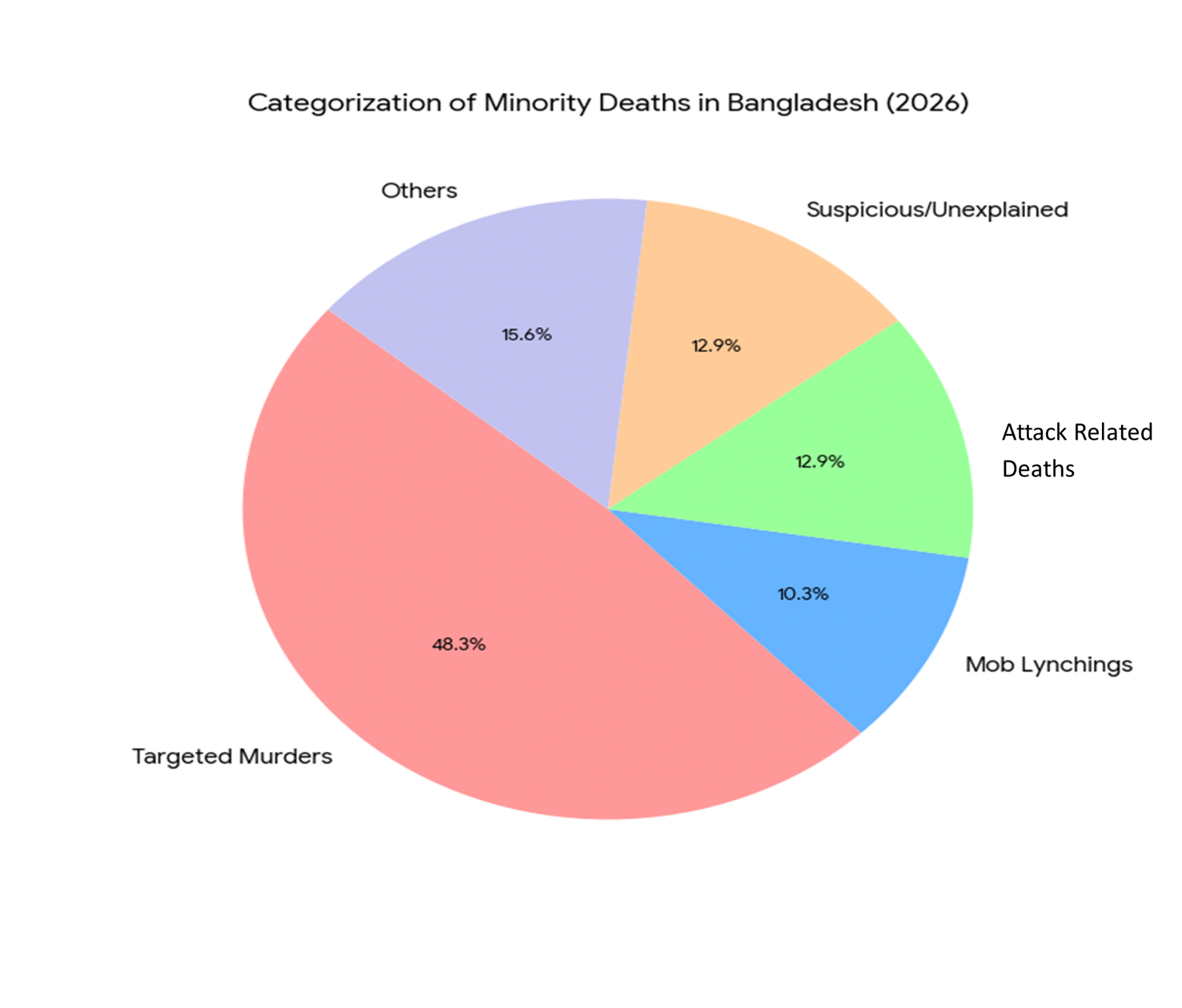
- January 3-6: The year began with the targeted murders of Khokon Chandra Das (Shariatpur), Rana Pratap Bairagi (Jessore), and Moni (Sarat) Chakraborty (Narsingdi). Rana Pratap, a local editor, was reportedly targeted for his secular stance.
- January 10-11: Joy Mahapatra, Samir Das and Proloy Chaki were killed in quick succession. Samir Das was brutally attacked in Feni, his death highlighting the lack of police protection in minority-heavy districts.
- April 2026: Violence persisted into the spring, with the killings of Nayan Das (Sadhu) in Cox’s Bazar and Ranjit Sarkar in Faridpur.
By the time the truth comes out, lives are already lost. By targeting minority business owners and political organisers, this movement aims to drive capital and stability out of the country.
No One is Safe: The Purge of Moderates
The violence has also moved beyond religious lines to target the very people who could lead a peaceful, sovereign Bangladesh. In the first months of 2026, the BNP (Bangladesh Nationalist Party) has seen its grassroots workers systematically hunted.
- On January 22, Hasan Mollah a dedicated BNP organizer, was shot in front of his office in Keraniganj. He died two days later, leaving behind a family and a community that saw him as a shield against extremism.
- Scores of other moderate workers have been silenced in what many call a "premeditated purge" to ensure that the political centre is hollowed out, leaving only the most radical voices to dictate the nation's future.
By the end of April 2026, over 17 minority citizens and more than 40 BNP workers have been confirmed killed. Beyond the deaths, over 2,500 families have fled their homes, and hundreds of temples and properties have been reduced to ashes. Financing and logistical support from Pakistan's ISI to help Jamaat-e-Islami and its student wings (Shibir) dominate the streets and neutralise political opponents. Concentrating killings in districts bordering India to provoke regional friction and complicate bilateral relations.
A Choice for the Future
"Pak-Jamaat" nexus thrives on the idea that fear can override the spirit of a sovereign nation. To stop this, it isn't enough for the government to just "condemn" the acts from a distance. True change requires looking at the human cost the widows, the orphaned children and the empty seats in local shops and deciding that the rule of law must protect every citizen, whether they are Hindu, Muslim, or a political activist. This nexus continues to exploit the current political transition to settle old scores and destabilise the sovereign state of Bangladesh. It requires a rigorous crackdown on foreign-funded extremist cells and the protection of political workers across the spectrum. Without immediate international attention and internal reform, the documented names of the Hindus and BNP workers lost in 2026 will not be the last.
If the foreign-funded extremist cells are not dismantled now, the names we honour today will only be the beginning of a much longer, more tragic list. Bangladesh deserves a future where a man like Khokon Chandra Das can walk home without fear and where a worker like Hasan Mollah can serve his community without paying for it with his life. These killings signify a wider attempt by hardliners to eliminate any moderate political competition that favours a sovereign, democratic Bangladesh over a radicalised state. By removing BNP workers, the "Pak-Jamaat" nexus seeks to hollow out the political centre, leaving the populace with no choice but to succumb to extremist hegemony and creating a permanent state of civil unrest.
References: