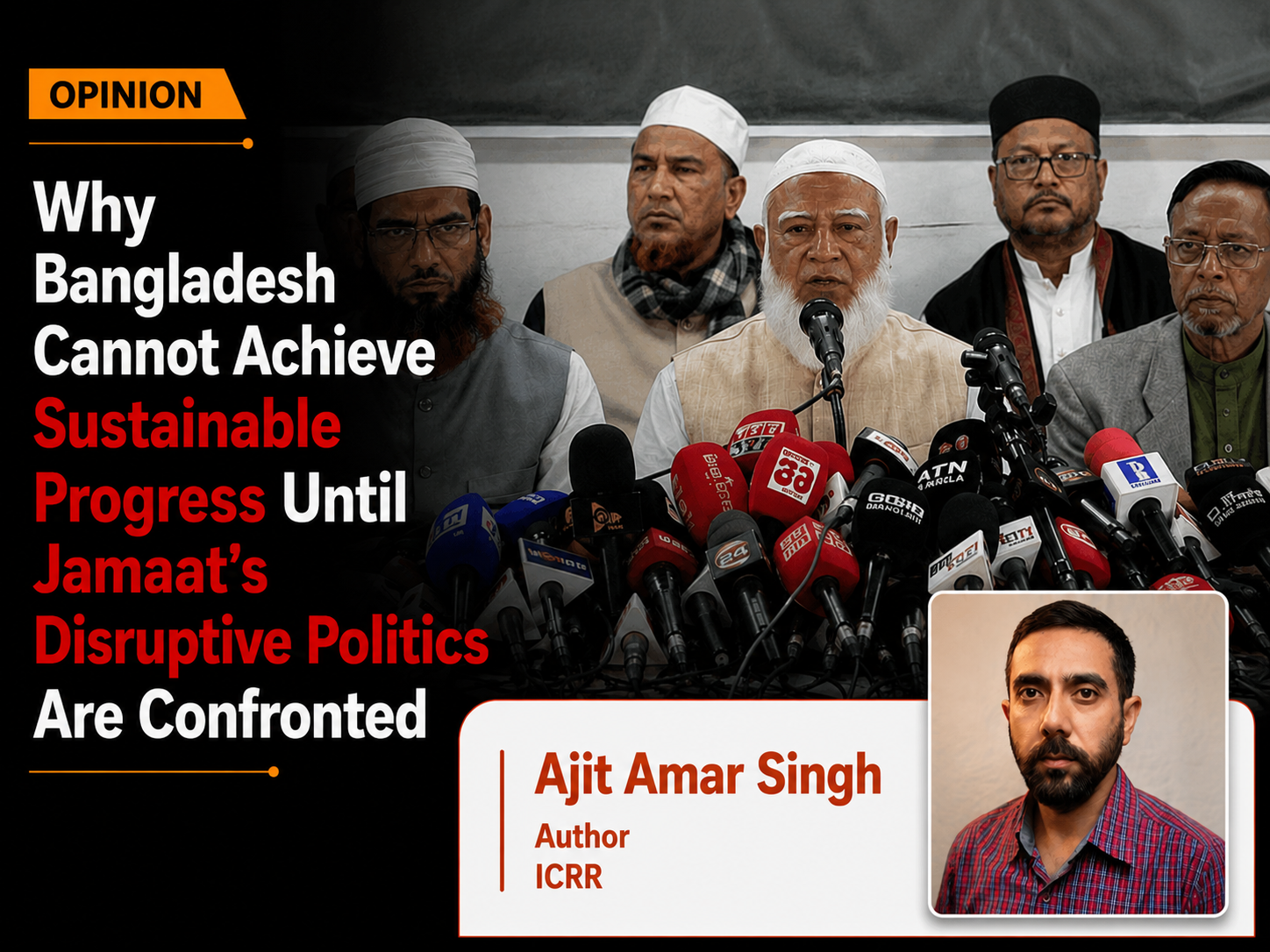
Why Bangladesh Cannot Achieve Sustainable Progress Until Jamaat's Disruptive Politics Are Confronted
From the unresolved legacy of 1971 to contemporary pressure politics, minority intimidation, and institutional confrontations, Jamaat-e-Islami"s resurgence raises serious questions about Bangladesh"s democratic stability and long-term development


A Political Landscape Transformed
Bangladesh's politics has been remade since Sheikh Hasina's ouster in August 2024. Jamaat-e-Islami, banned and deregistered for years over its 1971 record, had its ban lifted by the interim government in August 2024 and regained formal registration in June 2025. In the February 2026 general election, the Jamaat-led 11-party alliance emerged as the country's second political force: the Bangladesh Nationalist Party (BNP) won a landslide 212 seats, while Jamaat took 68 seats - a record high, up from a previous ceiling of 18, making it the main opposition in parliament for the first time. The youth-led National Citizen Party (NCP), formed in February 2025 by leaders of the 2024 student uprising, contested as a junior partner in that same alliance and won 6 of the 30 seats it contested.
Who Leads These Parties
Jamaat is led by Ameer Shafiqur Rahman, now Leader of the Opposition, with Mia Golam Parwar as secretary-general. The NCP's leadership includes convener Nahid Islam (elected from Dhaka-11), chief coordinator Nasiruddin Patwary (defeated in Dhaka-8), and regional chief organisers Hasnat Abdullah (elected, Cumilla-4) and Sarjis Alam (defeated, Panchagarh-1). All four rose to prominence as student organisers during the 2024 protest movement before entering formal politics. The NCP describes itself as centrist and "Bangladeshpontha," and its decision to ally electorally with Jamaat has been controversial within its own ranks, prompting several liberal-leaning members to leave the party in protest.
The Unresolved Legacy of 1971
Jamaat's predecessor organisation opposed Bangladesh's 1971 Liberation War and aligned with the Pakistani army; scholars and human rights groups have documented that Jamaat-linked militias took part in atrocities during the war, including killings of Bengali intellectuals and Hindus, as part of a campaign many historians describe as genocidal. Jamaat leaders were later convicted by Bangladesh's International Crimes Tribunal and it remains true that the party has never issued a formal, unqualified apology for its 1971 role - its official position has consistently been to reject the accusations rather than acknowledge and apologise for them. This is a legitimate and long-standing grievance raised by victims' families, secular civil society and rival parties and it continues to shape suspicion of the party today even as it wins parliamentary seats.
Mass-Produced Extremist Symbols: The Rise of a Profitable Jihadist Ecosystem
The industrial-scale manufacture of jihadist flags by Jamaat and NCP supporters in Bangladesh signals a worrying institutionalisation of radical networks that extends beyond isolated cells into organised, profitable supply chains; mass production not only supplies domestic militants but also feeds transnational extremist markets, normalises iconography across communities and reveals gaps in enforcement, finance tracking, and border controls that allow illicit materials to flow freely. Such commercialisation of militancy indicates radicalisation is evolving from fringe recruitment into an ecosystem- combining local producers, sympathisers, and shadow financiers- that monetises ideology, broadens outreach through merchandised symbols, and raises the risk of permanent social entrenchment unless countered by coordinated law enforcement, financial disruption, targeted counter-radicalisation campaigns and community-led resilience programs.
The Palashbari (Rangpur) Ram Murti Controversy
One of the most closely watched incidents began in early June 2026 in Palashbari, Rangpur division, where a Hindu temple committee had begun constructing what would have been Bangladesh's largest murti (statue) of Lord Ram at the Sri Sri Radha Govinda and Kali Temple. Leaders of hardline groups, including the Insaf Kayemkari Chhatra Sramik Janata organisation, publicly called for the statue to be demolished, framing it - falsely, according to the temple committee and commentators such as writer Taslima Nasreen - as a foreign-backed, India-linked conspiracy rather than a religious construction project. Facing threats and inflammatory social media campaigns, the temple committee announced it was voluntarily suspending construction "to maintain communal harmony," saying it would resume only after consulting stakeholders. This was not a government order to close the temple, but a suspension forced by intimidation from radical preachers and organisations - a distinction that matters for accuracy, even though the practical effect for the Hindu community was the same: a place of worship silenced by threat of mob violence. Jamaat as a national party was reported to have organised this campaign, though the broader climate of Islamist assertiveness that has followed its political resurgence is widely cited by minority-rights groups as a contributing factor.
Image Courtesy: https://www.asianews.it/
Jamaat and NCP’s Pressure Politics Threaten BNP’s July Charter Agenda
Jamaat and NCP leaders are increasingly being viewed as forces that could threaten the BNP’s ability to implement the July Charter, especially if they continue to rely on pressure politics instead of democratic cooperation. Their confrontational posture and hardline messaging risk turning a national reform agenda into another cycle of confrontation, where compromise is replaced by agitation and street mobilisation. If this continues, Bangladesh could again be pushed into instability, with political actors prioritising power struggles over the country’s recovery and unity. The danger is not only to BNP’s political plans but also to the broader future of Bangladesh, because repeated unrest, polarisation, and radical rhetoric can weaken institutions, frighten investors, and damage public confidence. Sustainable progress will only be possible if all parties choose responsibility over disruption.
The Fight Over Islami Bank
Since April 2026, Islami Bank Bangladesh - the country's largest private lender and historically linked to Jamaat-affiliated shareholders and its student wing, Islami Chhatra Shibir - has become a flashpoint between the ruling BNP and opposition Jamaat. After the bank's managing director was sent on leave and board seats shifted toward parties associated with the S Alam Group (which had seized large stakes in the bank under the previous Awami League government), Shafiqur Rahman filed a parliamentary notice demanding shares be "returned to their rightful owners" and warned that Jamaat activists were "ready to take to the streets to liberate Islami Bank." The government's home minister, Salahuddin Ahmed, pushed back sharply, stating plainly that "Islami Bank is not Islam... Jamaat-e-Islami is not Islam," and accusing Jamaat of conflating a commercial ownership dispute with religious identity to mobilise supporters. The bank has since suffered heavy deposit withdrawals - reportedly over Tk 4,000 crore in a week - amid the standoff, a real economic cost regardless of which side is right.
A Fragile, Contested Moment
In sum, while Bangladesh’s path to stability and sustained development depends on many actors and structural reforms, the record since 2024 shows that the disruptive politics associated with Jamaat-e-Islami and the National Citizen Party pose a particularly acute obstacle. Their resurgence has been accompanied by organized intimidation, communal incidents, and aggressive pressure politics that erode social cohesion, deter investment, and divert government attention from urgent economic and institutional reforms. Unless these parties and their local networks are confronted through concerted legal action, stronger enforcement against violent and extremist activity, and inclusive political dialogue that protects minority rights, Bangladesh will struggle to build the consensus, investor confidence and policy consistency needed for long-term progress.
References:
https://x.com/salah_shoaib/status/2071257099854852604?s=20