Jamaat and Pakistan Army in 1971: Inside Bangladesh’s Genocide
The Jamaat and Pakistan Army led 1971 genocide stands as a testament to the resilience of a nation that fought not only a foreign military occupier but also a betrayal from within. The alliance between Jamaat-e-Islami and the Pakistan Army during the Liberation War remains one of the darkest chapters in South Asian history. Driven by the goal of preserving a so-called “unified Islamic Pakistan,” Jamaat’s leadership provided the ideological and ground-level infrastructure for mass killings, rape and ethnic cleansing designed to erase Bengali identity through systematic violence..
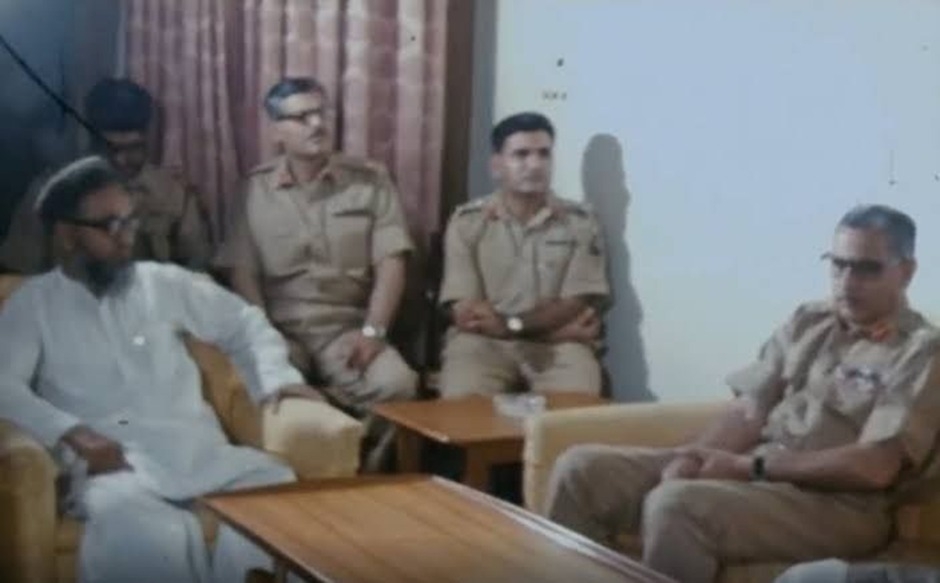 Golam Azam, the Amir of the Jamat-E-Islami, in a meeting with Lieutenant General Tikka Khan, Major General Rao Forman Ali and other senior Pakistani army officers on the 11th of April, 1971.
The Anatomy of Betrayal
Jamaat-e-Islami’s role was far more than political support; it was a systematic integration into the machinery of mass murder. Under the leadership of figures like Ghulam Azam and Motiur Rahman Nizami, the party provided the "eyes and ears" that the Pakistan Army lacked. While the military focused on the front lines, Jamaat’s paramilitary wings, the Razakars, Al-Badr and Al-Shams, targeted the unarmed.
- The Razakars: A force of approximately 50,000, mostly recruited by Jamaat, functioned as local enforcers who identified pro-liberation Bengalis for execution and guided the army through unfamiliar terrain.
- Al-Badr & Al-Shams: These elite death squads, drawn from Jamaat’s student wing (Islami Chhatra Sangha), were indoctrinated to believe that murdering fellow Bengalis was a religious duty. They were the architects of the most surgical and cruel operations of the war.
Atrocities as Ideological Cleansing
The collaboration resulted in concentrated violence aimed at breaking the soul of the emerging nation through three specific genocidal pillars:
1. The Murder of the Mind: As defeat became inevitable in December 1971, Al-Badr units carried out a premeditated "intellectual vacuum" operation. They abducted and murdered 1,111 intellectuals, including 991 teachers, 49 physicians, 42 lawyers and 13 journalists. These victims were tortured and dumped in mass graves like Rayerbazar. The objective was explicit: to ensure the new nation would be born without a leadership class.
2. Weaponized Sexual Violence: Estimates suggest between 200,000 and 400,000 women were subjected to systematic rape. Jamaat collaborators often served as "spotters," identifying women from pro-independence families and facilitating "rape camps" for Pakistani soldiers, using sexual violence as a tool of social destruction.
3. Religious and Ethnic Cleansing: Labelling the Hindu minority as "Indian agents," Jamaat cadres led mobs to burn villages and slaughter civilians. This targeted persecution was the primary driver behind the exodus of 10 million refugees to India, the vast majority of whom were Hindu.
A Persistent Threat to Bangladesh’s Future
The history of 1971 is not merely a memory; it is an active warning for the future. For decades, Jamaat-e-Islami has attempted to rebuild its influence by embedding itself within educational and financial institutions, often masking its radical core with populist rhetoric.
The Danger of Radicalization: Jamaat’s vision remains in direct conflict with Bangladesh’s constitutional secularism. Security analyses have frequently pointed to ideological links between Jamaat’s student wing, Islami Chhatra Shibir and extremist networks. Their presence continues to pose a risk to the pluralistic fabric of the country, as they seek to replace democratic institutions with a hardline, intolerant state structure.
Accountability and Justice: The International Crimes Tribunal (ICT), established in 2009, finally tore away the veil of impunity. Chief architect Ghulam Azam died in custody as a convicted war criminal, while others like Nizami and Abdul Quader Molla (the "Butcher of Mirpur") were executed. These trials were not just legal proceedings; they were a defense of the Republic’s moral foundation.
Defending the Republic
The role of Jamaat-e-Islami in 1971 is a matter of documented record, not interpretation. It chose ideology over humanity and annihilation over coexistence. Any attempt to sanitize or politically rehabilitate this entity without a full moral reckoning is an assault on historical truth and the millions who sacrificed their lives for freedom.
Bangladesh was liberated from a foreign army, but the struggle against the internal ideology that facilitated the genocide continues. To safeguard the future of the nation, the betrayal of 1971 must remain exposed. The blood of the martyrs is non-negotiable, and the "Spirit of 71" remains the only shield against those who wish to see the country slide back into the darkness of radicalism.
References:
https://www.eurasiareview.com/30062012-nizami-admits-conducting-genocide-in-bangladesh-analysis/
https://www.bbc.com/news/world-asia-15794246
https://hmh.org/education/bangladesh-1971/