Bangladesh Election 2026: Calculated Coup Under Yunus
As Bangladesh approaches the national elections scheduled for February 12, 2026, the interim administration led by Muhammad Yunus stands accused of executing a sophisticated strategy to dismantle the nation's democratic foundations. What was initially presented as a neutral caretaker period has evolved into a calculated campaign of institutional capture and political exclusion. By weaponizing state machinery and leveraging communal instability, the Yunus regime is rewriting the rules of the state to ensure its own long-term political survival.
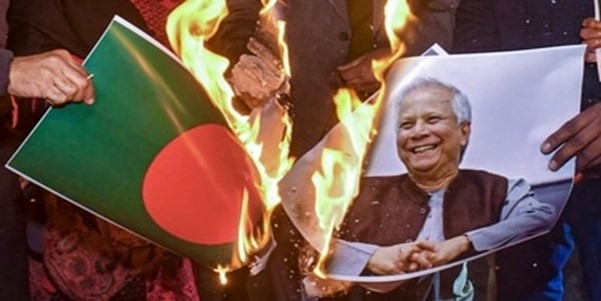
Image Courtesy: Hindustan Times
Personal Agenda: The "July Charter" and Institutional Capture
The primary vehicle for the regime’s political gain is the "July Charter," an 80-point constitutional reform package crafted without a parliamentary mandate. In a move widely condemned as an overreach of caretaker authority, the administration has paired the adoption of this charter with a national referendum on the same day as the general election.
This coupling is a calculated effort to bypass the mandate of a future elected parliament. By presenting the charter as a "Yes/No" choice alongside the vote, the regime is forcing a pre-designed ideological framework onto the electorate. This strategy allows an unelected body to bake its personal vision into the state’s foundation permanently. Since August 2024, the regime has systematically purged the judiciary and civil service, replacing independent officials with loyalists to ensure that the levers of power remain under its control long after the February vote.
Treating Minority Bloodshed as Political Capital
Perhaps the most disturbing element of the Yunus regime’s strategy is its handling of the escalating violence against religious minorities. Each attack on a Hindu home, temple or business is a tragedy, yet the regime appears to treat this bloodshed as strategic political capital.
Voter Suppression via Communal Terror: As the February election nears, reports from human rights organizations highlight a surge in "communal terror." This violence serves a clear political purpose, it drives minorities, who have historically formed the bedrock of secular voting blocs, away from the polls. By failing to provide security, the regime ensures that the electorate is "filtered" by fear.
Redrawing Constituencies: The displacement of minority populations allows the regime and its radical allies to redraw the political influence in key constituencies. With secular voices silenced or in hiding, the path is cleared for hardline factions to dominate the newly "purified" electoral landscape.
Impunity for Radical Enforcers: The administration has consistently downplayed atrocities, with the Chief Adviser’s office recently claiming that most incidents in 2025 were "criminal" rather than "communal." This narrative rewards radical enforcers with impunity, effectively turning them into a shadow force that maintains the regime's grip on power through intimidation.
The Architecture of Political Exclusion
The upcoming election is being criticized as an engineered exercise in exclusion. By using anti-terrorism laws to ban the nation’s largest secular party, which represents nearly 60% of the population, the Yunus regime has ensured that millions of citizens are locked out of the democratic process.
The Ban on the Opposition: The country’s largest secular party remains banned from the contest. By excluding a party that commanded nearly 30% to 60% support in various polls, the Yunus regime has ensured that millions of voters are disenfranchised before the polls even open.
Weaponized Legal Systems: The Election Commission recently declared over 700 candidate nominations invalid, targeting those perceived as a threat to the interim government's "third force" candidates.
Media Blackout: The revocation of accreditation for over 160 journalists and the ongoing harassment of dissenting voices have ensured that the regime’s narrative remains unchallenged in the lead-up to the most pivotal election in decades.
A Call for Accountability
The Yunus regime’s trajectory shows a deliberate dismantling of democracy for political gain. By turning minority bloodshed into a political asset and using the state to pursue a personal ideological legacy, the administration is sabotaging the nation’s stability and the safety of its citizens.
To save the democratic future of Bangladesh, there must be immediate Protection for Minorities, communal violence is met with genuine legal accountability and restoration of Political Pluralism. An election that excludes the country’s largest secular voice cannot be considered legitimate. Pressure for Democratic Restoration, the "July Charter" must not be allowed to bypass the will of a truly elected parliament. The world must recognize that a "managed election" built on communal terror is not a victory for democracy, it is its funeral. The restoration of democracy requires a state that belongs to all its citizens. A regime that builds its power on the fear of its own people and the exclusion of its rivals cannot claim to be a guardian of the law.
References:
https://en.prothomalo.com/bangladesh/politics/wn89esnfhr
https://www.bbc.com/news/articles/czd031z5md9o
https://www.bssnews.net/national-parlament-election-2026/350496