Violence Against Hindus in Bangladesh Exposes Deepening Minority Crisis
over the past six months, Bangladesh has experienced a troubling surge of violence that has disproportionately affected its Hindu minority. Reports of mob lynchings, arson, sexual violence, intimidation and targeted killings have become disturbingly frequent. Families speak of living in fear, businesses close early and neighbourhoods once known for coexistence now carry the weight of anxiety. These incidents are often preceded by unverified accusations-most commonly blasphemy-after which crowds gather, anger escalates and violence erupts before any legal process can intervene. What makes this period particularly alarming is not just the brutality of the attacks but the sense that such acts are becoming normalized, treated as unfortunate but inevitable rather than unacceptable and preventable.
Governance Under Scrutiny: The Yunus Administration’s Challenge.
The interim government under Muhammad Yunus has not merely failed to protect minorities; it has presided over their growing vulnerability. Yunus assumed office with unprecedented international credibility, yet that moral authority has been squandered through indecision, silence and administrative paralysis. Instead of firm governance, the country has witnessed a pattern of cosmetic responses, routine condemnations, hollow assurances of investigation and empty calls for restraint; while violence continues unchecked. This is not a failure of capacity alone; it is a failure of will. Delayed arrests, weakened charges and a deliberate reluctance to name communal hatred as the motive have sent a clear message to extremists: the state will look away. Under Yunus’s watch, accountability has collapsed, deterrence has evaporated and mobs have grown bolder. The bloodshed unfolding across Bangladesh is not happening despite the government - it is happening because the government has allowed it to happen.
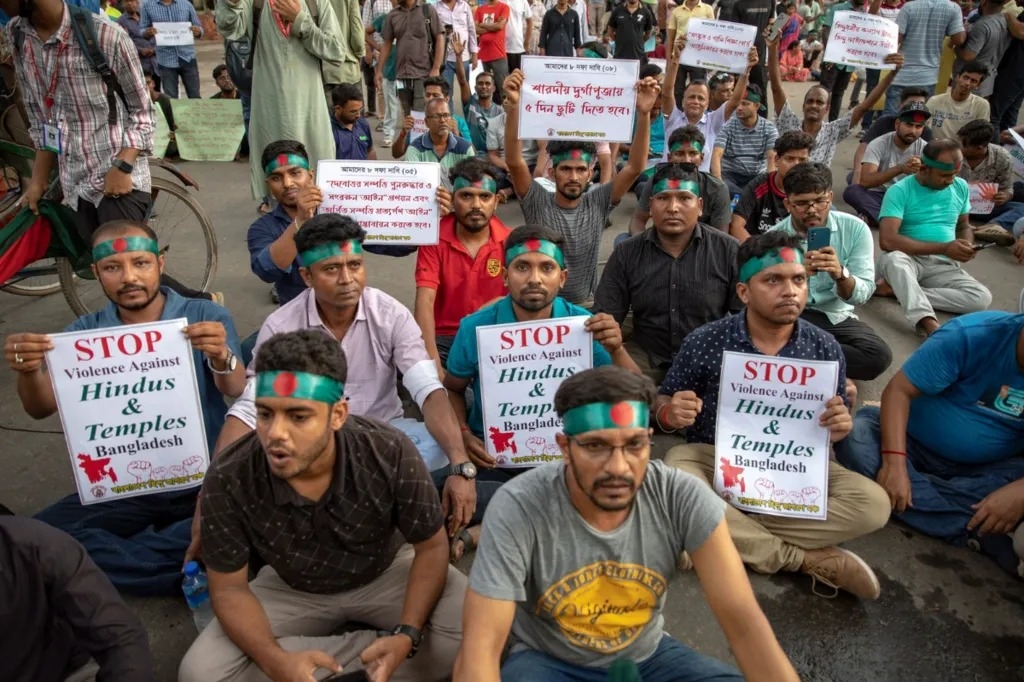
Targeted Killings: The Hindu Minority Under Siege in Bangladesh.
Bangladesh’s Hindu minority has been the target of a shocking wave of violence. On 18 December 2025, Dipu Chandra Das was lynched in Bhaluka, Mymensingh, beaten and set on fire over false blasphemy allegations. In the following weeks, Khokon Chandra Das in Shariatpur, Amrit Mondal in Rajbari and Bajendra Biswas in Mymensingh were brutally murdered by mobs. In early January 2026, Rana Pratap Bairagi in Jessore and Mani Chakraborty in Narsingdi were killed, while Mithun Sarkar drowned in Naogaon while fleeing attackers. These are only the reported cases; countless others likely went unreported, kept out of the media, underscoring the depth and scale of this violence. The repeated attacks reveal a terrifying climate of fear and impunity gripping the Hindu community, as the state fails to intervene or hold perpetrators accountable.
Impunity in Plain Sight: The Meaning of a Viral Moment
Public concern deepened when a viral video emerged from inside Shayestaganj Police Station in Habiganj district, capturing Mahdi Hasan, general secretary of the Habiganj district unit of the Anti-Discrimination Student Movement, openly confronting officers and boasting about violent acts, including allegedly burning down Baniachang Police Station and killing Hindu police officer Sub‑Inspector Santosh Chowdhury by setting him on fire. While such clips circulating on social media must still be approached with careful verification, the reaction to this footage made clear that the problem goes far beyond one video. It has become a symbol of a deeper belief that perpetrators feel untouchable and above the law. When individuals appear confident enough to boast of past violence and issue threats within spaces associated with law enforcement itself, it signals a collapse of deterrence and a breakdown of law and order. For minority communities, such moments reinforce the fear that institutions meant to protect them are either overwhelmed, compromised or unwilling to act with the firmness needed to uphold justice and prevent further atrocities.
Extremist Narratives and the Question of Political Space
Human rights defenders and political analysts have also raised concerns about the broader ideological environment in which this violence is occurring. Jamaat-e-Islami, a party with a controversial history and a well-documented opposition to secularism, is frequently mentioned in public discourse. There is no publicly available, conclusive evidence proving direct orchestration of recent attacks by Jamaat leadership. However, critics argue that the narratives used to incite violence-religious vigilantism, collective punishment and the weaponization of blasphemy accusations-closely mirror long-standing extremist rhetoric. When such narratives circulate unchecked, and when political calculations appear to tolerate hardline influence, radical elements at the grassroots level may feel emboldened.
Allegations of external instability and regional concerns.
Some commentators have gone even further, suggesting that foreign actors could exploit internal tensions in Bangladesh. These discussions often mention Pakistani intelligence, citing past examples in South Asia where religious and political rifts have been exploited to destabilize enemies. It must be stated clearly that the operational involvement of Pakistan's ISI in the recent violence is strongly believed. Analysts argue that times of political change and social unrest create vulnerabilities that outsiders can exploit through disinformation, ideological funding, or proxy networks. Even without direct involvement, the consequences—communal fear, international criticism, and internal division—are typical of the common consequences of instability.
Human Rights in Retreat: From Principles to Reality.
Beyond political debates lies the undeniable reality of human rights erosion. The right to life is compromised when mobs kill with impunity. The right to equality is undermined when minority communities feel less protected than others. The right to justice weakens when investigations stall or cases lose momentum. International human rights standards are explicit: states have a duty not only to refrain from abuse but to actively prevent, investigate and punish violations committed by non-state actors. By this measure, critics argue, Bangladesh is falling short of its constitutional promises and international obligations. The cumulative effect is a loss of trust-once eroded, extremely difficult to restore.
Social and Economic Costs of Insecurity
The consequences of continued communal violence extend far beyond immediate victims. Social cohesion suffers as fear replaces trust. Economically, instability discourages investment and disrupts local markets, particularly in regions where minority-owned businesses play a significant role. Regionally, repeated reports of attacks on Hindus strain relations with neighbouring India, where such issues resonate deeply. Perhaps most concerning is the quiet displacement that often goes unnoticed: families relocating internally or considering emigration because they no longer believe the state can guarantee their safety. History shows that when minorities begin to leave, the cultural and economic fabric of a nation is irreversibly altered.
Possible Futures: Choices Before the State
Bangladesh now stands at a crossroads with three broad possibilities ahead. The first is course correction. This would require decisive action: fast-tracked trials in communal violence cases, clear acknowledgment of communal motives where they exist, proactive protection of vulnerable neighbourhoods and an unambiguous reaffirmation of secular constitutional principles. The second path is managed decline, where violence is condemned rhetorically but allowed to continue at a “manageable” level, leaving minorities alive but insecure. The third and most dangerous path is normalization, where mob justice becomes routine, extremist narratives harden and fear becomes a permanent feature of daily life.
Conclusion: A Test That History Will Remember
Every government is ultimately judged not by its intentions or international image but by how it protects its most vulnerable citizens. For Bangladesh, this moment will define the legacy of the Yunus administration far more than speeches at global forums or diplomatic accolades. The question is stark and unavoidable: Will the state choose courage over caution, accountability over appeasement and human dignity over silence? The violence of the past six months is not merely a crisis; it is a warning. How Bangladesh responds now will determine whether it reclaims its promise of pluralism or allows fear to become its defining feature. History is watching and so are those whose lives depend on the answer.
References: