The Betrayal of the Dalits: Thol Thirumavalavan
How The Dravidian Movement Betrayed Dalits Of Tamil Nadu
Date: 15-Apr-2026
Total Views |


The Betrayal of the Dalits: Thol Thirumavalavan
Part 3: How The Dravidian Movement Betrayed Dalits Of Tamil Nadu
A powerful Dalit assertion movement swept Tamil Nadu in the 1980s and 1990s but the wily Dravidian politicians managed to pull the plug
By Sandhya Ravishankar
Since 1967, Tamil Nadu has been ruled by the two Dravidian parties - the Dravida Munnetra Kazhagam (DMK) and the All India Dravida Munnetra Kazhagam (AIADMK).
Under the DMK regime especially, Dalit rebellion was always put down with force. The Dravidian party throws freebies piecemeal at the Dalit community while denying them their basic Constitutional rights as equal citizens of the nation. If Dalits voiced their anger and asked for more than mere symbolism, the rebellion was always quelled and the leaders of the rebellion appropriated by the Dravidian parties.
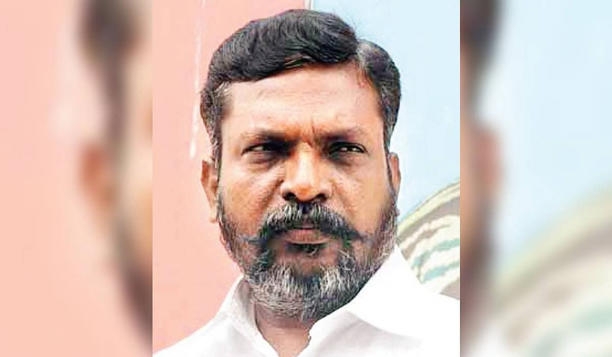
The story of Thol Thirumavalavan is one of Dalit assertion and of the community losing its voice yet again.
The Betrayal of the Dalits: Thol Thirumavalavan
In the 1960s, in Bombay, an avant-garde movement called the “Little Magazine Movement” was born and it caught the imagination of Dalits in other states. Short literary magazines, often cyclostyled (precursor to photocopying), gave space to Dalit writers and others to express their anger and sorrow at the denial of their rights.
In 1972, the founders of the “Little Magazine Movement” formed a party called the Dalit Panthers (later renamed Bharatiya Dalit Panthers). In 1980, A Malaichamy, a lawyer, was appointed as its Tamil Nadu head.
In the 1980s, a wave of anger was unleashed by dominant caste groups across the nation as the Mandal Commission report was made public. Atrocities against Dalits spiked – as they were perceived to be the key potential beneficiaries of reservation.
Back in Madurai, Malaichamy called the outfit Dalit Panthers Iyakkam (DPI) (iyakkam means movement) and set about petitioning the government and mobilising Dalits living in cheris (slums). Malaichamy met with limited success, since the authorities either ignored his petitions demanding Dalit rights or they simply tangled the petitions up in bureaucratic red tape. Even favourable court orders did not yield results from the government for Malaichamy and his Panthers.
In 1990, after the demise of Malaichamy, a young Thol Thirumavalavan took over as the head of the DPI. He had been working as a government official in the Madurai Department of Forensic Sciences. Known for his rousing oratory in support of a separate Tamil Eelam while in Madras Law College, he infused new energy and zest into the DPI.
The outfit was renamed Viduthalai Chiruthaigal (Liberation Panthers), a hat tip to the Liberation Tigers of Tamil Eelam (LTTE) which was battling against the Srilankan government at the time.
Under Thiruma, as he is known, the Panthers expanded their presence across Tamil Nadu, most notably in the Northern districts of Tamil Nadu. Their message was simple – “Adanga maru! Atthu meeru! Thimiri ezhu! Thiruppi adi!” (Refuse to be cowed! Break boundaries! Rise up strongly! Hit back!)
Young Dalits flocked to the outfit, inspired by their revolutionary ideas of taking power back from the dominant castes. DPI members urged Dalits to come together and raise their voices against injustices heaped on them. They asked Dalits to pool funds and bid for government contracts, which were usually awarded to the dominant castes. They carried out massive protests, road rokos and demonstrations to force the Dravidian parties to act against social and financial injustices inflicted on the community. Their message was propagated through audio cassettes containing the speeches of Thiruma, which were sold at bus stands and markets.
The Chiruthaigal leadership was disillusioned with the Dravidian parties. They had experienced the hypocrisy of the political class firsthand and their main enemy was the Dravidian party and its movement.
Author Michael A Collins quotes a key leader of the outfit, Sinthanai Selvan, in his book Elusive Democracy (Cambridge Press, 2025). “Though they supplanted Brahmins from political power and converted the [lower caste] Sudras into a powerful political force, they were not concerned about Dalits,” Selvan is quoted as saying.
The book also notes another glaring example of this hypocrisy. “... Selvan juxtaposes the fervent uproar against Black July that reverberated across Tamil Nadu to the pin-drop silence that characteristically followed violence against Dalits. Whereas Tamil nationalists spoke passionately about the atrocities in eelam, these same figures, who were typically from intermediate caste backgrounds, were silent when strikingly gruesome acts occurred against Dalits on their own soil.”
As Dalits across the state began to question the status quo, the dominant castes reacted with violence. The infamous caste tensions in 1992 at the village of Chennagarampatti in Madurai district resulted in two Dalits being hacked to death. The anger of the dominant caste members was over the Dalits landing a government tender to cultivate temple land.This was a flashpoint for the Dalit outfit and protests broke out in many parts of the state.
The Panthers kept records of atrocities against Dalits and circulated these as pamphlets in slums and Dalit colonies in rural Tamil Nadu.
“The exploitation and oppression of unrestrained caste fanaticism continue unabated across Tamil Nadu. Recently because the cheri people [Dalits] requested their share in the tamarind tree tender for Vazhudhavur Villupuram, caste fanatics murdered the innocent Arumugam. In 1992, because the cheri people won a tender for tamarind in Narasingampatti village near to Madurai, caste fanatics torched sixty huts and proceeded to make a mockery of our people’s plight… [in that same year] two innocent men, Ammasi and Velu, had their throats slit for acquiring a lease on temple lands in Chennagarampatti.” (Viduthalai Chiruthaigal pamphlet quoted in Elusive Democracy by Michael A Collins, 2025)
In the 1980s, S Ramadoss formed the Vanniyar Sangam - an association of 27 Vanniyar castes, demanding reservation and other sops. The Vanniyars fall under the MBC or Most Backward Classes in the state but they are a dominant caste, largely present in the Northern districts. The Vanniyar Sangam became the political party PMK (Pattali Makkal Katchi).
In 1989, during the run-up to the election, protests demanding reservation were sparked off by the Vanniyars. They cut down trees and blocked arterial roads and highways. They indulged in violence against the Dalits, torching huts and assaulting them.
Thol Thirumavalavan and his fellow Panthers hit back against the PMK and caste clashes abounded on the ground.
1996 proved to be the turning point for the Panthers. In Madurai district’s Melavalavu village, the Dalit Panchayat President Murugesan, Dalit Vice President Mookan and four other Dalits were hacked in broad daylight by Thevars from the village.
The Panthers had struggled against the Dravidian regime for over two decades with no end in sight. While the courts upheld their petitions, the administration and the police refused to comply. Instead of ensuring that Dalits got the rights due to them, the administration convened ‘peace meetings’ when caste tensions rose. The police, on the other hand, unleashed brutality on Dalits.
The Chiruthaigal decided that electoral representation was the only route now left to them. They decided to call themselves the Viduthalai Chiruthaigal Katchi (VCK) and contest the 1999 general election.
Here too, the shrewdness of Dravidian politics came to the fore. The VCK was no match for the sheer money and muscle power of the DMK and AIADMK. The electoral kettle of fish was vastly different from what the VCK wanted to originally navigate.
“... smaller upstart parties like the VCK face greater pressure to align with a powerful coalition partner to be electorally viable, and to counteract myriad other challenges they face in elections, such as their comparatively limited access to campaign resources, signal material disadvantages, and caste stigma. This reinforces their reliance on dominant parties, which can undercut their political autonomy and impede their growth,” observes author Michael A Collins in his book Elusive Democracy.
And that was exactly what happened. In the early 2000s, Dravidian parties witnessed an erosion in their voteshare and were forced into coalitions with multiple parties. Thol Thirumavalavan and his VCK became the token Dalit party representation, given a seat or two to contest. They were given only Reserved seats, never General ones. No ministries were given even in a winning alliance.
In 1999, 2004 and 2016, the VCK contested alone. They did not notch a single win. While in coalition with Dravidian parties, they won 5 seats in the General elections and 7 MLA seats until 2024.
Money and lust for power pushed the Dalit agenda to the backseat as the Dravidian parties eroded the VCK. Now the VCK has been reduced to a mere echo of the DMK. Thirumavalavan hails and defends the same EVR whose machinations gave political and social power to the perpetrators of violence against Dalits.
Through the entire electoral journey of the VCK from 1999 to date, multiple honour killings have taken place in the state. Violence against Dalits has never stopped despite the measly representation accorded to the VCK. The state machinery continues to follow the same modus operandi against Dalits as it did in the 1980s.
The Dalits of Tamil Nadu were betrayed by an important voice in 1999. They lost their voice unequivocally and have learnt to be silent again.
Sandhya Ravishankar
Sandhya Ravishankar is Chennai based journalist/author with 3 decades of political, social and investigative journalism